

In pursuit of the Rooster; catching Roosterfish in Panama

Now it’s worth saying at the outset that no flies were harmed in the writing of this article.
By that I mean that, as committed a fly-angler as I am, there are times when events conspire to take fly fishing opportunities off the table. And so it was for my long-awaited week fishing the incredible waters off the Azuero Peninsula in southern Panama. I knew from the outset that this was going to be a ‘multi-discipline’ trip, and if you’ve read my previous articles on fishing in Cuba, you’ll know that whilst I have a strong preference for picking up a fly rod, the fact is that I’m first and foremost an angler… and that means that if fly fishing is off the table for any reason, I won’t sit in a bar and mope about it; I’ll deploy (and enjoy) any method that gets me on the fish!
With that core principal in mind, I invested in a lot of prep for this trip, which all started with eagerly confirming the booking with Panama fishing expert Sam Wadman. Sam runs Fish Pedasi, his own boat-centred guiding business based in the sleepy little town of Pedasi, some 5 hours drive south-west of the cacophonous Latin-American metropolis of Panama City.

(Google Maps)
Pedasi sits on the Azuero Peninsula, facing into the Gulf of Panama. The region supports an incredibly productive fishery which benefits from two key contributory factors:
The annual dry-season (Dec – Apr) cold-water upwelling; Seasonal northerly trade-winds during the dry season drive warmer surface waters off-shore, and this allows cooler, nutrient-rich waters from the pacific to well-up in the gulf, supercharging the region’s ecosystem.
A ban on net-fishing along an extensive range of the region’s coastline, vastly reducing the commercial pressure on fish stocks, and further boosting the food chain and the abundance of sport fish species.
On a practical level, this means the region is stuffed with an astonishing array of marine life, from plankton to Humpback Whales, and it’s a sport fisherman’s dream.
This is rural Panama at its most charming too. Unspoiled, uncommercialized and underpopulated, the coastline runs largely uninterrupted for mile upon mile, backed by forest, hills and farmland. It provides a verdant backdrop to the exciting prospects out on the water, and makes for a chilled-out stay, during which visitors can recharge aching muscles between frenetic days afloat.
It's fair to say the locals probably thought Sam, originally from Brighton in the UK, was plumb crazy when he first decided to start his sport fishing enterprise in Pedasi, but despite at the time being a complete novice in boat handling terms, his irrepressible enthusiasm and no-holds-barred willingness to learn and embrace local life, quickly got him not only accepted and established, but a fast developing reputation for being an excellent skipper.

Sam Wadman; host, guide and captain, fishpedasi.com
Nowadays, Sam (and his super-talented artist wife, Leila), are very much part of the fabric of life in Pedasi. It seems he still has the ‘Crazy Englishman’ reputation, but if you ask if anyone if they know him, the answer is almost always the same: “Ohh, you mean ‘fisherman’ Sam, right?”, and in my experience, that statement is accompanied by a warm, wide smile.
Whilst it may have taken Sam a little while to crash-course his boat handling skills at the outset, one thing Sam never lacked in was angling skill. Runner-up on BBC Television’s high-profile, globe-trotting fishing competition program ‘The Big Fish’, Sam is an intuitive and adaptable fisherman, who clearly absolutely loves the sport, and can’t wait to share his experience with his clients.
Over the years, Fish Pedasi has established itself with an enviable reputation for producing the calibre of fish most anglers would give their right arm for, with specimens regularly well into record-breaking territory.
The sheer variety of species that come to Sam’s boat, the aptly named ‘Buenos Vibras’ (Good Vibes) is mind-blowing. The headline act is undoubtedly the Roosterfish, and that alone was enough of a draw for me to sign-up for a week with Sam. The waters around Pedasi disgorge some absolutely monstrous Roosters, and this fish has long been a bucket-list species for me.

Sam with one of the most famous inhabitants of the waters off Pedasi – the Roosterfish!
And it’s far from the only jaw-dropper on offer. Gigantic Cubera Snapper and Almaco Jacks lurk amongst the reef pinnacles, rocket-fuelled Yellowfin Tuna smash bait-balls offshore, often with majestic Sailfish getting in on the action. The surface is routinely patrolled by blisteringly fast Sierra Mackerel, Barracuda, Mahi-mahi and huge Needlefish. Black-tip sharks often gatecrash, and marauding Jack Crevalle of world-class size regularly test light tackle to the limit. Mullet Snapper, Broom-tailed Grouper, Blue Trevally, Pompano, Pacific Red Snapper, Rose Spotted Snapper, Bonito, Rainbow Runner… the list of hard-fighting reef species seems inexhaustible. And what’s more, the area plays host at times to vast shoals of huge, enigmatic and legendary Milk-fish, which (to my astonishment) no one really fishes for, such is their reputation for being ‘uncatchable’. Heck, even the fish destined for live-bait put up a scrap.

They really do! Blue Runners… tough fish.
So, there’s no doubting the pedigree of the fishery, or the ease with which Sam can navigate it to give his clients the best possible shot at the stupendous sport it has to offer.
Roll with it
But let’s loop back to the start here. This is very much a multi-discipline destination. Naturally I wanted to explore the options for deploying my beloved fly gear, especially as I had two of Orvis’ epic new Helios rods accompanying me. Whilst Roosters are notoriously challenging on the fly, the potential for Yellow-fin tuna, Mahi-mahi, Sailfish and even Milk-fish, had me salivating at the prospect. Sam did temper my expectation a little in the lead-up to the trip, citing the fact the it would very much depend on conditions and a stroke of luck as to how and when I might be able to chuck some fluff. Wisely as it turned out. But we also went into considerable detail on gear and lures to open up all avenues of opportunity.
Breaking it down, the methods broadly fall into the four categories of fly fishing, jig fishing, surface-lure fishing and live-baiting. There’s variations on a theme of course, and it’s fair to say that the jig and surface lure fishing probably best suit the fishery in terms of the balance of conditions and opportunity. But hey… this is fishing we’re talking about – anything can happen!
Watching the weather obsessively in the lead-up to a trip like this is a hard thing to resist, but it really is largely pointless; It’s not like you can cancel at the last minute if it’s looking iffy… you just have to roll with it. Upon arrival in Pedasi after our long journey, we were given an orientation tour of the little town by Sam and shown where we could stock up with supplies and get a good meal out. Talk soon turned to the fishing of course, and I read the tone in Sam’s voice all too easily and held my breath as I heard him explain we had some pretty iffy weather in the forecast for the next few days. The nett effect of that was that we’d probably be excluded from pushing offshore and be forced to stick close to the coast in case we needed to run for cover.
You have to have complete faith in your guide and skipper in these circumstances – they know the fishery after all – so I just accepted that news verbatim. This is where flexibility is essential if you want to keep fishing, and certainly being willing to roll with whatever the Azuero Peninsula throws at you and switch tactics accordingly is key. I was therefore pretty relieved that I’d come prepared…
ALL the gear and no idea…

Some months before my trip, Sam provided an exhaustive list of viable lures, jigs, rigs, hooks, clips, leaders and… well just about everything you could think of. That doesn’t mean to say you have to go out and buy ALL that stuff.
A chat with Sam in the lead-up narrowed the field and highlighted the essentials, and because (where jigging and popping was concerned) the brutal strength of the fish there best suit single-piece rod-blanks, I opted to use Sam’s rods and reels rather than risk mine (and have the additional luggage allowance woes). There’s a nominal daily charge for that, and whether that suits you will depend on whether you feel it worth the investment to buy your own gear or take yours with you… each to their own. But Sam’s kit was perfectly suited to the job and well maintained. I’d certainly have no qualms about using it on a return trip.
It's fair to say I do have a bit of a boy-scout ‘be prepared’ mentality when it comes to fishing, especially abroad, so certainly took way more ‘just in case’ stuff than I probably needed; the vast majority of it never saw the light of day. What did get used was good fluorocarbon leader in 40, 60 and 80lb BS, serious lure clips, a few 8 & 10/0 Mustad Demon circle hooks, and heavy duty spare assist hooks for the jigs.
The allure of lures…
I must confess that in the lead-up to the trip, I did kind of lose control a bit. I’d frankly forgotten just how mesmerizingly tempting lures are!
What Sam provides is really a list of lures to pick from, not (as I ended up interpreting it as) a list you need to buy from top to bottom!
The fact of the matter is that we actually used just 3 poppers in total (Yo-Zuri 165 Mag poppers were the go-to, in just two colours; bronze and sardine), although they were pretty heavily mauled by the end of the week. Upgrading the trebles to 4/5x Owners before flying out was definitely a smart move – I don’t think the original hooks on any of the lures would have stood up to the beasting, and you certainly wouldn’t want to risk losing that fish of a lifetime for the sake of a few quid in upgrades. Sure, I couldn’t help buying other colours and sizes of lures, and some beefy Nomad ‘Chug Norris’ poppers too (amongst others), but the Yo-Zuri’s performed admirably. Spoiler alert: I did get cleanly bitten-off twice by big Sierra Mackerel but we were able to scoop-up the free-floating lures afterwards, so luckily losses on the top-water side of things were avoided.
And we’re off
Day 1, 6.30 am, and we were met on the beach by a bombastically enthusiastic Sam, obviously one of life’s early risers! Sam’s boat is launched daily from the shore. A small gang of barefooted local fishermen were there assist, so after throwing our gear on board, we all flexed a few muscles to push ‘Buenos Vibras’ into the water. Once afloat, we hopped on and skimmed out of the bay. Conditions didn’t feel bad at all but all around the indistinct horizon, thunderous, towering anvils of cloud loomed, and beneath them, the sky had a livid, bruised look. The odd flicker in peripheral vison suggested distant lightning stabbing at the blue-black murk. It certainly didn’t invite a 20 mile run out to the tuna grounds.

Uno, dos, tres...
So the plan was to target the shallow reefs along the coastline and surrounding Iguana Island.
Pop ‘till you drop
This fishery is renown for it’s top-water bite, and when it’s really on fire, fishing with poppers there is world-class, heart-stopping stuff, especially with the potential array of resident predators.
Diana, my lovely wife and willing fishing companion for the week, was introduced to the heavy popping gear and given a quick crash-course on the method. I’d fished poppers before but it was a good re-cap; a sharp, slightly downwards-angled sweep of the rod-tip with a crisp stop, swiftly returning the rod to it’s starting position whilst taking up the created slack on the reel, then repeat. With a steady, measured ‘tac…tac…tac’ rhythm, the poppers blooped loudly on the surface, ringing the dinner bell.

Popping lessons
But the aforementioned dodgy weather seemed to be having a depressive effect on the fishing. This had started a couple of days before. The two of us rang that bell for all it was worth, at several marks, but the surface remained eerily quiet as distant thunder rumbled ominously. I did manage to illicit a couple of hits, and caught sight of one hefty Sierra Mackerel scything past the lure, but nothing connected. A cast across a rip at one end of Iguana Island finally produced a modest Barracuda.

It's always good to get that first fish.
Out here they’re considered good eating and are thankfully not plagued by Ciguatera, a toxin that originates in algae, (particularly in the Atlantic and Caribbean), and concentrates in fish flesh as it gets carried up the food chain. Fish like Barracuda, especially the older fish, can carry levels in the muscles that can induce awful, even dangerous, symptoms if eaten. But like I say, in the Pacific, it’s not an issue, so the ‘cuda was humanely dispatched for dinner.
That one fish aside though, it was clear that any consistent surface action was not on the cards. By now the wind was beginning to squall too; nothing that jeopardised the day’s fishing but enough to push the boat along against the tide. “So what?”, you might think… but the problem with that was that it meant jig-fishing was going to be off the menu too. Sam tested the option and sure enough the line slanted away at far too steep an angle to make it viable at that point. Jig fishing works best when you’re able to remain directly above the jigs as they’re worked.
With a tough day grinding on, no surface activity to present lures or flies to, and jigging precluded in the wind and current combination, we convened a quick strategy meeting. The fall-back position was to go large. That is to say switch to heavier multiplier gear and get a live bait in the water.
Live from Pedasi…
I’ve done plenty of livebait fishing over the years, most of it in the UK, out on the Portland race in Dorset, tempting bass on live sandeel. It can be hugely effective. Indeed I’ve had many days on the bass when I’ve literally stopped fishing some hours before the trip finished because I’ve caught enough.
But the waters of Panama contain far bigger quarry. This is the realm of the Roosterfish. Every season Sam’s guests do battle with some truly huge Roosters, and usually the very biggest fall to live-bait. As this magnificent species was no.1 on my hitlist for the trip, and as our unaccustomed shoulders were weary from the constant casting, a break free-lining livebait seemed an acceptable idea.
The favourite livebait out here is the Blue Runner. It’s found in shoals on the surface, usually feeding on pin-fry, and is caught using sabiki lures. It is an extremely tough and resilient fish, making it a long lasting bait that’s ideal for tempting a big predator. What I hadn’t really thought about was the necessary upscaling of the bait itself. A big predator needs a big bait. The Blue Runners that Sam dropped into the live-bait tub were a good 2lb. Watching the shoals fizzing under the surface made me wish I’d brought my 6wt flyrod with me… what Sam regarded as bait, I think I would have had a whale of a time targeting in their own right!
Sam skilfully mounted a bait fish using a live-bait needle and cord-loop, and this was fixed to a fearsome 10/0 Mustad Demon circle hook. He has a particular method which he ran through – the bait is allowed to free swim, so it’s dropped in and the boat slowly trolled forward allowing the line to run out about 75-100m or so under free-spool. At that point you clamp the spool under your thumb but crucially don’t engage the reel. Sam eases the boat up to a very sedate trolling speed, sufficient to cover ground across the reefs, whilst being slow enough to allow the bait to jink about freely and get down in the water column.
The rod nods constantly as the livebait tugs on the line. Any sudden increase in the urgency of that movement indicates that the bait is beginning to panic… a reliable signal that something is in the vicinity. Sam explained the drill – if anything hits the bait you yell, release the spool under your thumb (feathering it just enough to prevent any over-runs) whilst he guns the engine and gives a 3 second countdown: 3 -2- 1- NOW! On that command, the lever is flicked up (Sam uses the trusty, bomb-proof Shimano TLD20’s for this type of approach) and the spool is re-engaged, driving home the circle hook, and BAM! Fish on!

All set... let's do it.
Well. That was the plan. Time ticked by as we chatted and laughed and watched the nodding rod. A humpback whale surfaced some way off with a whoosh of it’s blowhole, proving a momentary thrill, and the Frigate Bird colony on the island reserveprovided more spectacle. On two flanks, the sky had darkened threateningly and the boom of thunder was getting distinctly closer. Beneath the clouds the horizon had disappeared, blurred by distant but advancing torrential rain.
A black-tip reef shark made an unwelcome appearance, briefly raising our hopes of a Rooster, but ruining a bait, and in the end, having circled the Island twice and covered the adjacent, normally productive Rooster marks, Sam was left scratching his head.
Two storms seemed to be converging in a pincer movement, and a little rain was now pattering from the sky. Aware that we may have to abruptly have to make a quick getaway from the encroaching weather, we took one more drift position and got back on the popping rods for the dying minutes of the day.

Uh-oh... that doesn't look (or sound) good!

Those minutes ticked away. Then there was an encouraging thrash behind my bronze Yo-Zuri Mag-popper and the line tightened. I set the hook robustly and felt the welcome weight of another fish through the rod… finally! It wasn’t big, but hey… when you’re reduced to scratching, a win’s a win, especially on the last cast of a tough day. Actually it was a Sierra Mackerel – pretty small by local standards, but big enough to complete the menu for the evening’s planned meal with Sam and his wife Leila.
And that was it – day 1 done. We’d dodged the storms, hadn’t blanked (never to be taken for granted), seen our first whale and ended the day with a stupendously good fish meal at the little restaurant ‘Con Cuba’, with a few beers, lots of laughs and excellent company.

Day two, and the forecast was still iffy, the sky still brooding, dark and angry-looking. The topwater bite was still off too, despite exploring some extremely fishy-looking new marks with the poppers. There were a couple of adrenaline spikes when lures were hit, but no connection made, and no more so than when my popper was cut cleanly off by a big Sierra Mackerel that came out of nowhere like a missile and sliced through the leader like a hot knife.

This was tough fishing. In periods like this, you just have dig in and hang on to the fact that it becomes an odds-game. By the afternoon, even Sam was beginning to look stressed. I coach and guide introduction days for saltwater fly fishing back home in South Wales, so I’m very familiar with the pressure you feel when you want your clients to have a good time. With a fishery normally as prolific as this one, such a dead spell was especially acutely felt, and it had Sam apologising on behalf of the uncooperative ecosystem.
So, with day two grinding by thus-far fishless, we took the decision to once again resort to the live bait and go all-in for a big one.
At this point we were treated to one of the most memorable and extraordinarily magical wildlife encounters we’ve ever had.
We’d seen a couple more humpback whales in the distance during the morning, but as we headed round Iguana Island again to drop our livebait, we were treated to the sight a huge female gently nursing a playful calf on the edge of a shallow bay. The ‘little’ one (a very young calf clearly, a mere 8 or 9 feet long), flopped about on the surface, seemingly having a great time splashing and waving it’s fins and tail, whilst mum hung in the water beneath, occasionally slowly surfacing to take a noisy breath.

We drifted quietly to within about 30 metres, with neither mum nor calf remotely bothered by our proximity. It was truly awe inspiring. I mean, we all know whales are big, right? You see them on TV, you know they’re huge. And I’ve seen them in the distance before in Canada too. But honestly, getting that close to one when it rises up to the surface and really getting the true scale of it (and realising it could roll over this little boat we’re in and reduce it to splinters without even noticing) is just on another level. It’s incredible, and even alarming (especially when the calf slapped the water with its tail, and mum immediately responded in kind which seemed like a keg of dymanite going off… now that was a ‘Whoa!!!’ moment!).

What a privilege. And even more so to have been able to share that experience with Diana; over the years I’ve witnessed many amazing and beautiful sights whilst fishing, and only ever been able to tell her about them second-hand. It’s a lovely thing to be able to truly share moments like that. I think we could have stayed there all afternoon, but after a good 15 minutes, we decided to leave them in peace and get on with the matter in hand.
Moving out onto the reef another blue Runner was rigged up and dropped out the back. It felt like a re-run of the day before. Expectation seeped gradually away as time rolled past and the bait went unmolested. The only action came from a couple of small Black Tip Reef Sharks that thought they’d have a go. Whilst I was welcoming the attention, Sam was cursing them; apparently he’s not a fan and spent a spirited minute or two yelling off the stern of the boat.
“I don’t mind catching one.” I said.
“Yeah… but then I have to deal with it.” Replied Sam, darkly. Sounds like there might be a story there somewhere, but I didn’t press the issue.
In a sense though, the little sharks did me a favour. The bait had been mauled and eventually gave up the ghost. The rod stopped nodding and it was clear that a fresh bait was required.
Sam knocked the engine into neutral as I retrieved, and he rigged up a new bait. The blue runner went over the side and disappeared. Sam leant across to put the rod in the holder whilst he sorted the engine out, but before either of us could react the rod slammed awkwardly over and the spool ripped around under his thumb, giving him a good old fashioned friction burn as the line tore out, before he nigh-on threw the rod across and I could engage the reel and let the fish pull against the clutch.
And good grief, pull it did! I fumbled with the rod and tried to get the butt into position as it yanked and lurched with such ferocity that I stumbled forwards and had to fight to regain my balance.

0 to 100mph in the blink of an eye!
It’s in moments like that that I’m reminded why fishing in the tropics is so much fun. The fish are just super-charged! It made run after run against a clutch set tight enough for me to have to seriously use my body-weight to stop it. It was a proper high intensity work out; from the somewhat resigned and deflated quiet of a day seemingly destined to be a dud, to the chaos and excitement of fortunes turned in the fraction of a second – that’s what I love about fishing!
Inevitably we started second-guessing what it might be. Sam suggested a Cubera perhaps. And then raised my hopes further.
“It could be a Rooster…” He said. “It’d be nice to get that monkey off your back!”
True.
As I got the upper hand, I squinted into the water, looking deep down for colour, pumping the rod and clawing back line. Eventually I saw a bronze flash, spiralling up from deep blue. Sam peered in.
“Ohhh, it’s an Almaco Jack… Reef donkey! Nice fish!”
“It’s not small!” I managed, exercising the British art of understatement.
“It’s not”. Sam agreed. “Must’ve been hitting ‘em way up in the water – very unusual. But we’ll take it!”
There was the usual tense moments keeping the lunging fish clear of the prop whilst trying to manoeuvre into the optimum position for Sam to grab the short leader and lay hands on the fish, but then, with a grunt and a grin, he lifted the fish in, proclaiming it to be one of the best Almaco’s of the season so far.


Not a Rooster... but I'll definitely take it!
It was unhooked, briefly admired and photographed and plunged back into the water where it powered away in the blink of an eye. Diana had captured most of the event on video and a clearly relieved Sam beamed directly into the camera and said “We needed that one!”. He was right!
The whale encounter and the huge relief of the Almaco Jack made for a truly memorable day. During our meal on day one with Sam and his wife Leila, we learned that Leila was a very talented artist. So at the end of this amazing day, Diana asked Sam if Leila would take on a small commission and commemorate our magical whale experience by painting us a picture of the mother and calf. Needless to say Leila was more than happy to oblige, but of course it would take a few days.
Hard yards
Day three arrived. Two days in and still not a peep of the elusive Roosters. The pressure was building… Except in a barometric sense, where yet further falls were expected. The breeze was up a little more and the day became a rinse & repeat experience of the first two.
Despite the lift of yesterday’s ‘reef donkey’, there was still a grimness to Sam’s expression as, from mark to mark to mark, the fishless nautical miles ticked by. With the weather still forcing us to stick close to shore, the surface still resolutely silent, and the conditions frustratingly still keeping jigging off the options list, even Sam was forced to acknowledge that this was one of the toughest weeks he’d had this year. But if yesterday taught us anything, it was to keep the faith.
Which is sometimes easier said than done.
I’ve always noticed that as fishing gets tougher, it also gets quieter. The banter and chat gradually subsides and eventually gets replaced with an intense, hardened silence as every atom of conscious awareness is focussed on the end of that line. It’s as if all the energy on the boat is concentrated on just a few cubic centimetres of space around that hook. It becomes almost trance-like.
So when, after an eternity, the rod suddenly nods frantically and then lurches under sudden, significant weight, the gunning of the engine and the “Three, two, one… NOW!” yell from Sam is a bit like having an ice-bath tipped over you during meditation!
The weight was on!
And then, worryingly, it wasn’t. The rod straightened and the line felt light.
“Don’t tell me it’s come off…” groaned Sam.
I wound frantically. The rod bucked a little and then straightened again. I kept winding as we all held our breath and stared at the rod-tip for what felt like an age.
Then, suddenly it pulled savagely down with a sharp hiss as line was torn off the spool.
Again the rod bucked and kicked and I staggered about the stern like a drunken fool. The clutch whined under the pressure, and I felt shock at the power of the fish. This one really had me huffing and puffing in the cloying humidity. The tell-tale flash of white against the deep blue told Sam everything he needed to know.

We got colour!
“It’s a Rooster!”
Cue the silent, internally monologued mantra of fisherman everywhere in that situation: (Don’t come off, don’t come off, don’t come off…)
It’s heart stopping stuff, and every violent lunge and sudden twist forces a skipped beat as you dance about trying to maintain the maximum pressure whilst steering the line away from potential danger.
Eventually I got the Rooster to point where it hung in the water 15 metres out, rod nodding rhythmically in a stalemate. From there I was able to coax it gradually towards Sam who, eventually, skilfully slid a hand under it’s gill-plate and carefully, triumphantly lifted this incredible fish aboard.

Naturally at that point I turned to Diana and mugged furiously at the camera she was holding. I’m a 10 year old kid in situations like this.


One of the themes I’ve written about repeatedly over the years is angling’s never ending litany of ‘firsts’, and each and every one is a solid-gold memory. My first Rooster Fish was one of those for sure. What an absolutely magnificent creature. A slab of muscle, pearly white, a great gaping mouth, that beautiful sweep of curving black stripe, and of course that iconic, remarkable dorsal comb that gives the fish its name. It surely has to be one of the most stunning looking of all fish.

For such a tough critter in the fight, they are surprisingly slow to recover, so need to be handled extra-carefully, returned to the water quickly, and gently supported until they’re ready to kick away strongly. Watching that fish fading back into the depths was a magical moment. It was, ultimately, what I’d come to Panama for. It wasn’t a monster by Pedasi standards, but that really didn’t matter.
The next bus is the no.2 from Pedasi…
And the thing about a fisherman’s fortune is it’s a fickle and unpredictable thing. Not much more than 45 minutes later I found myself gritting my teeth and cursing my aching arms as Sam laughed and declared that this time I had ‘proper’ one on! It was the proverbial ‘second bus’…and it felt like one too!

Oh yeah... now this one is MUCH heavier!
This one had me leaning my entire weight back into and gave me one heck of a work-out. It was considerably bigger than the first, and once (eventually) boated, with me breathing hard and mopping sweat from my stinging eyes, there was no way I could heft it’s weight for a photo. I rested the bulk of the fish in my lap, happy as a loon, and tried to fix every detail in my memory before almost going overboard returning it.

Monkey? What monkey?
Feeling somewhat freed of the burden, Sam ventured that we could go and take a look for some of the fabled Milkfish. We’d been keeping an eye out for them throughout – in particular off the northern and southern points of Iguana Island where at times they congregate in their hundreds. But the choppy seas seem to have put them down and the shoals had been conspicuous by their absence.
Every day, I’d loaded two flyrods into the boat, rigged and ready to go. A stunning 10wt Orvis Helios paired with an equally stunning Mirage reel, floating line and bespoke milkfish fly I tied specially for the trip, and an even beefier Helios/Hydros pairing with a tropical fast sinking line and 4/0 sardine fly (again, self-tied and a pattern I was rather proud of).

Alas though, the conditions meant that these would only come into play if we were lucky and stumbled across a good old surface blitz. But they were there if needed. I did chuck at some super-fast-moving bonito shoals a couple of times, but they were feeding on tiny fry, and I had nothing small enough. They were also amazingly easily spooked.
We did spot a couple of Milkfish that afternoon – they almost looked like Tarpon – but they seemed to be solitary fish that slunk away as we approached. Certainly not the feeding shoals I’d hoped for. On the plus side, I was at least able to trial the open-water Milkfish fly I’d tied and I was delighted with the neutral buoyancy which meant the flies hung visibly 9-12 inches under the surface. I’ll be sure to bring them on a return visit.
Going it alone
On day four, Diana decided to take a day off and stay at the rather splendid villa we’d rented, leaving me to answer the 5.15 alarm call alone.
Winding down the road towards the beach, swerving around the suicidally stupid Turkey Vultures that have a tendency to shamble about in the middle of the road warming their wings, I noted the palm fronds hanging almost motionless. At the shore, the sea looked flatter, the sky clearer, and already the heat was building.
Sam and I headed out. The popper still went unanswered, but today, finally, the breeze had subsided enough for lightweight jigging gear to make an appearance, and that gave us the opportunity to explore what might be skulking on or near the bottom.
Jiggity-Jig
Jig fishing was entirely new to me. At least in its modern guise. I had to do a bit of reading up prior to the trip, and sit and watch a couple of Youtube vids to grasp the basics. Terms like ‘assists’, ‘slow’ jigs, ‘fast’ jigs etc all needed mentally unpacking. Then I’d sat down and looked at Sam’s tackle list surrounding jigging gear specifically. Lawks. Yet again my fear of leaving something out drove me to over-buy.
Oh, and it’s worth noting that for some reason, my jig wallets did attract some unwelcome attention from the Panamanian customs officers. I was ushered into a side room by a customs official who was clearly very upset that I’d interrupted his siesta, and who’s frosty, utter lack of a sense of humour (as I tried to explain what jigs were through the ancient art of mime), lowered the temperature in the room by a good 20 degrees. He eventually seemed rather displeased that he couldn’t find anything to throw me into jail for and I was grudgingly ushered out.

Having said that I’d over-bought, it does pay to have some choice, but with the conditions as they were, we fished almost entirely with 100g Williamson Benthos speed-jigs in pink/blue/holo and Orange/holo colours. We lost a few to unstoppable beasts in the reefs so I’d definitely take a few more of those next time, whilst maybe throttling back on some of the other slow-jig patterns, none of which saw daylight.
As for the jig fishing itself, well, for someone with all the natural coordination of an armful of broom-handles being dropped down a flight of concrete stairs, speed jigging started off being a slightly erratic affair. Sam was excellent in his advice and guidance, and I did eventually start settling into an even rhythm.
As there was only the two of us on the boat, I ushered Sam to pick up a rod and join me. That gave me an opportunity to watch an expert at work.
If you’ve not fished in this style before, it’s pretty strenuous stuff though, and in the relentless heat and humidity I found myself drenched in sweat. It’s tough on the shoulders too, especially a few days in, when previously underused muscles really start to protest at the repeated abuse.
Water, water everywhere...
That level of physical exertion demands constant, copious hydration in those conditions. I’m not used to it. I have plenty of experience fly fishing tropical flats (which is a sedate affair by comparison), and yet I found myself desperately short of fluid intake. Apologies if you’re of a sensitive nature here, but it has to be said: if your pee is a luminous tangerine in colour, you’re in trouble. And on day four, I was. A few hours in, I found myself feeling nauseous, weak, and sporting a thumping headache – it was a school-boy error on my part, and I had to force myself to drink litres and litres of water to get my body rehydrated to a sensible, healthy level. I felt I was poor company and apologised to Sam for not being my normal cheerful (if clutzy) self.
If you’re not used to tropics fishing, don’t underestimate this. You need to drink constantly (no matter how distracting the fishing) because if you don’t, you risk ruining a day’s fishing (or worse, you could end up in hospital!).
I did eventually rally round, and from that point on I rather enjoyed the speed jigging.
It was frenetic, physically demanding light-tackle fishing. Yes the moody fishery was still not switched on, and seemed hell bent on making us really work for it, but bites did come. After a couple of modest but extremely spirted Bonito, I finally drove the jig hard into something considerably tougher. The rod bent double, the tip pulled right to the water, and the reel creaked as the braid was ripped off.

I love light tackle fishing. It’s one of the primary reasons I love fly gear. There’s much more of a sense of parity between you and the fish. There’s a definite degree of jeopardy… the outcome is most certainly not guaranteed.
As I grunted and strained, switching the rod position back and forth as the fish went under the bow from one side to the other, Sam grabbed the go-pro and started recording. All his experience called this as a big Jack Crevalle, a hugely underrated fish and one that I happen to be a big fan of.

The tussle went on for some time, and when I finally gained enough line to get sight of the fish, Sam was right… it was a Jack Crevalle, and an absolute beast at that!
He made a grab for the thrashing fish with impeccable timing and lifted over the side.
It was worthy of admiration. I think Jack Crevalles are in impressive species - powerful, aggressive and ,in their way, brutally handsome. This fish had some serious firepower and looking at it's width it was easy to see why.
“Wooohooo… look at that – they don’t come much bigger than that!” Sam gleefully exclaimed.
Well the reef decided it would let us be the judge of the last comment, as some 10 minutes later it was role-reversal, with me on the camera and Sam straining under the power of another JC that, as it turned out, could quite literally have come from the same mould!

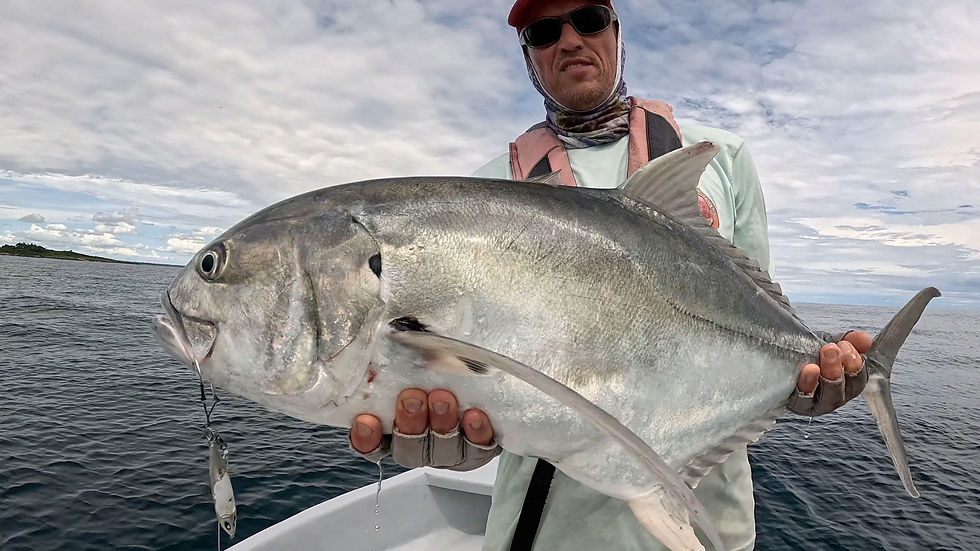
By the end of the day, with a few fish under our belt, it felt like things were turning in our favour.
It ain't over...
Day five, our final day, arrived. Diana was back on the crew today and there was a decision to be made. The weather was still presenting a degree of risk, but there was enough of an improvement to consider a couple of options: 1. Say ‘to hell with it’ and gun offshore 20 miles for tuna, essentially an all or nothing mission or 2. Head for the middle distance reefs to get out with the jigging gear.
After a little discussion we opted on the latter to stand the best chance of getting Diana on the fish. This meant a run south, round the point of the peninsula that had provided protection during the dodgy weather, stopping at various points. The conditions were certainly a fair bit lumpier.
On the way, we stopped again at a shallow reef to try our luck one more time with the poppers.
Diana and I sent our lures searching. After four days with very little to show for our popping efforts, it was therefore a huge lift when both our lures were subject to slashes from unseen predators. Twice Diana’s lure was attacked, but without contact being made. Then, in a repeat of earlier in the week, my popper was cleanly cut free by some razor-sharp mackerel teeth. It was retrieved and reattached, and not long after I finally felt a heavy thump as it was engulfed, and the line arced away at a phenomenal speed. Pretty quickly I was thrilled to identify the assailant, and a black comb sliced through the waves and a white body flung itself, thrashing, across the surface.

Topwater Rooster fishing - soooo much fun!
It was an excellent fight, and I was buzzing! The thrill of surface lure fishing is second to none (bar an eat on the fly) when it comes good, and when Sam lifted that Rooster on board I was grinning from ear to ear as I turned to Diana’s camera and croaked “At last! A Rooster on the popper!”.

After that we headed obliquely out to sea, towards a rocky Island sporting guano stained cliffs and an impressive lighthouse. We were treated to multiple whale sightings, often hearing the loud ‘whoosh’ from their blow-holes.

Sam set us up on a drift and gave Diana a run-through on the jigging technique. And this time the fishing was great!
Well… eventually. I typically started out going at it like a bull at a gate, wildly jigging as fast as I could, but my jig was tearing up through the water-column un-assailed.
My wife Diana, on the other hand, seemed to be immediately getting hit after hit, using the same kit and jig pattern as I was.

If you’re fishing with someone and they’re getting way more success than you, you’d be daft not to take a moment to try and understand why. Diana’s retrieve was certainly still speed-jigging but crucially it was in a much smoother fashion and at a good 30-40% slower than me. Clearly that was more effective. When I slowed my retrieve to match Diana’s, the effect was immediate and the rod slammed over under the weight of a feisty adversary! It’s not often I get to take fishing lessons from my wife, but there you go… every day’s a school day!
On the light tackle, the unseen fish gave a good scrap and eventually turned out to be a fine Rose-spotted Snapper, enthusiastically praised by Sam as a very fine catch for the table. It was quickly dispatched and put on ice for that evening’s dinner along with a feisty Bonito Diana had played in at the same time.


There then came a steady run of takes. Diana in particular was having mixed blessings – she was clearly hooking up on some seriously good fish, but they were managing to best her, even when Sam jumped to her aid to provide some additional braking power. Several times, unstoppable monsters dragged her jig inexorably down to the razor edged reef below and cut the line. A succession of fights ended in the same way – with a load groan and period of retackling.
My hook-ups were varied and spirited. No monsters, but a strong, scrappy, colourful roster of different reef species including a stunning Pacific Red Snapper, which completed the evening’s menu.

It was a great day to end a challenging but fantastic week.
That evening, Sam, Leila, Diana and I enjoyed a final , delicious fish dinner at Con Cuba (man, they know how to get the best out of their local catch!). Beers and G&T’s were happily consumed and Diana was brought to happy tears when Leila presented her with a beautiful painting of the mother whale and calf, which now hangs at home as a treasured reminder of something truly special.

Despite the tough conditions, Sam gave us an incredible experience at Pedasi. I haven’t even mentioned the dolphins, turtles, incredible birdlife, friendly people, deserted tropical coastline and rather distinct Panamanian music (!) but suffice to say, if it was this good when it was tough, how incredible will it be when it’s awesome?
So we’ve booked to go back… to see if we can find out.
If Roosters are on your bucket list species, or you want to sample the thrill of this incredible fishery, contact Sam Wadman here: FishPedasi and make a booking - you won't regret it!

I


Comments